
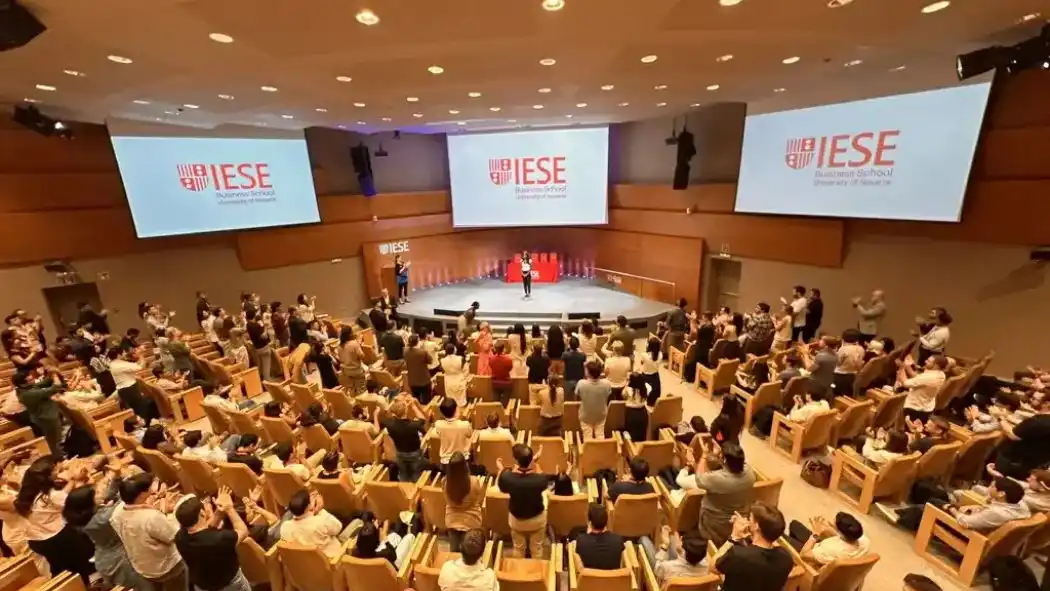
Over the past several weeks, I worked with a team in a Public Speaking for Leaders program at IESE Business School.
At the end of the course, several participants recorded short reflection videos. Listening to them, I was struck by how clearly they articulated what had changed for them, not in theory, but in behavior.
These were not abstract insights. They were practical shifts in how they approach conversations, decisions, and moments of leadership.
Here is what happened:
1. Presence became intentional
One participant described realizing that communication is not only about speaking well, but about how you show up in front of an audience.
Another recognized that when he stayed too attached to his script, he lost eye contact and distance crept in.
By the end of the program, both described something different:
- Connecting with themselves before connecting with the audience
- Reliving stories rather than reciting them
- Making eye contact deliberately
- Allowing their personality to be visible
One participant also noticed something more technical about presence: vocal clarity. He realized that when words are not fully articulated, authority weakens. In international environments where many leaders operate in a second or third language, pronunciation, pacing, and vocal energy become essential elements of executive presence. Calm leadership presence is valuable, but calm must not become flat or disengaged. Varying tone, pace and emphasis helps a message carry conviction.
Presence becomes something practiced and conscious, not accidental.
2. Message clarity replaced information overload
One participant reflected that being articulate was not enough. He recognized that statistics must serve the message. The content has to connect directly to meaning.
Another participant described a different dimension of clarity. He realized that being articulate is not the same as being precise. In leadership conversations, it is easy to speak fluently while still missing the question that was asked. His takeaway was clear and practical: answer the question directly first, then expand. That discipline strengthens credibility, especially in executive discussions where clarity and decisiveness matter.
This shift matters because when leaders anchor data to purpose, communication becomes clearer, decisions move faster, and alignment improves.
The result is not just a better presentation. It is stronger strategic communication.
3. Flexibility expanded leadership styles
Early in the program, we explored different leadership styles: calmness, energy, empathy, clarity and humor.
One participant articulated a key insight: there is no single correct way to lead or to speak.
Strength comes from being able to move between styles depending on the context and the audience.
This adaptability strengthens conversations across functions, cultures and stakeholder relationships.
A leader’s voice becomes versatile rather than fixed.
4. Emotional intelligence deepened under pressure
Working on hostile audience scenarios surfaced another important development.
Participants reflected on the value of:
- Showing empathy
- Managing emotions
- Being honest
- Avoiding overpromising
Although they are often thought of as presentation techniques, they are actually leadership behaviors.
These skills transfer directly into crisis conversations, difficult stakeholder meetings, and high-pressure environments.
5. Personal story became a strategic tool
Several participants admitted that in formal settings, they had avoided personal stories.
By the end of the course, they recognized that stories increase relatability and power, when they connect clearly to the message.
Storytelling shifted from optional decoration to strategic reinforcement.
That change strengthens engagement, credibility, and influence.
Several participants also noticed that strong storytelling requires a strong ending. Giving a good explanation is not enough. Leaders must land the point clearly so the audience connects, and leaves with a message that matters.
6. Self-awareness accelerated growth
Perhaps the most powerful reflection was about awareness.
One participant realized he had not been converting who he truly was into the person speaking in front of the room.
That moment of awareness unlocked change.
Feedback from peers, structured practice, and a supportive environment accelerated that development.
When leaders see themselves clearly, their communication evolves rapidly.
What this means for organizations
These reflections reveal something important.
Over the course of several sessions, these leaders stepped back and examined how they communicate, how they respond under pressure, and how they connect with the people in front of them. The changes they described were not theoretical. They were shifts in awareness and behavior that had already begun to influence how they show up in real conversations.
In practice, that development shows up in several ways:
• Executive presence
• Strategic clarity
• Stakeholder persuasion
• Emotional regulation
• Trust and credibility
• Leadership capability
What is striking is how quickly these shifts can begin once leaders pause to examine their communication with intention.
When that awareness takes hold, communication becomes more deliberate, leadership becomes more grounded, and the effects carry far beyond a single presentation or meeting. Conversations become clearer. Teams understand direction faster. Stakeholders gain confidence in the person leading the discussion.
Those shifts may begin in a communication program, but they carry forward into every conversation where leadership is required.
……..
If you or your team are working to strengthen leadership communication, I work with individuals, teams, and organizations to develop the skills described here.