
Practical ways to listen, think clearly, and maintain your professional presence during a Q&A
Your presentation has gone reasonably well. You prepared your material, rehearsed the main transitions, and communicated your main ideas clearly in English, your second language.
Then the Q&A begins.
You invite the first question and look out at the audience. A few hands go up. Even if you felt confident during the presentation, this can change from one second to the next when you no longer know what is coming.
Your posture changes, and you make yourself smaller. You bring your hands in front of your body or look away while trying to think. You may begin speaking before you have fully understood the question or decided how you want to answer it.
During the presentation, you had a structure. In the Q&A, you need to listen, understand, organize your thoughts, choose your words, and respond in real time. An unexpected or difficult question adds further pressure, particularly in a second language.
The aim is to stay connected to your thinking, communicate clearly, and maintain your professional presence while you respond.
These skills are valuable in any language. When you are speaking in a second language, they become even more important.
Stay open and grounded during the Q&A
Your response begins before you speak.
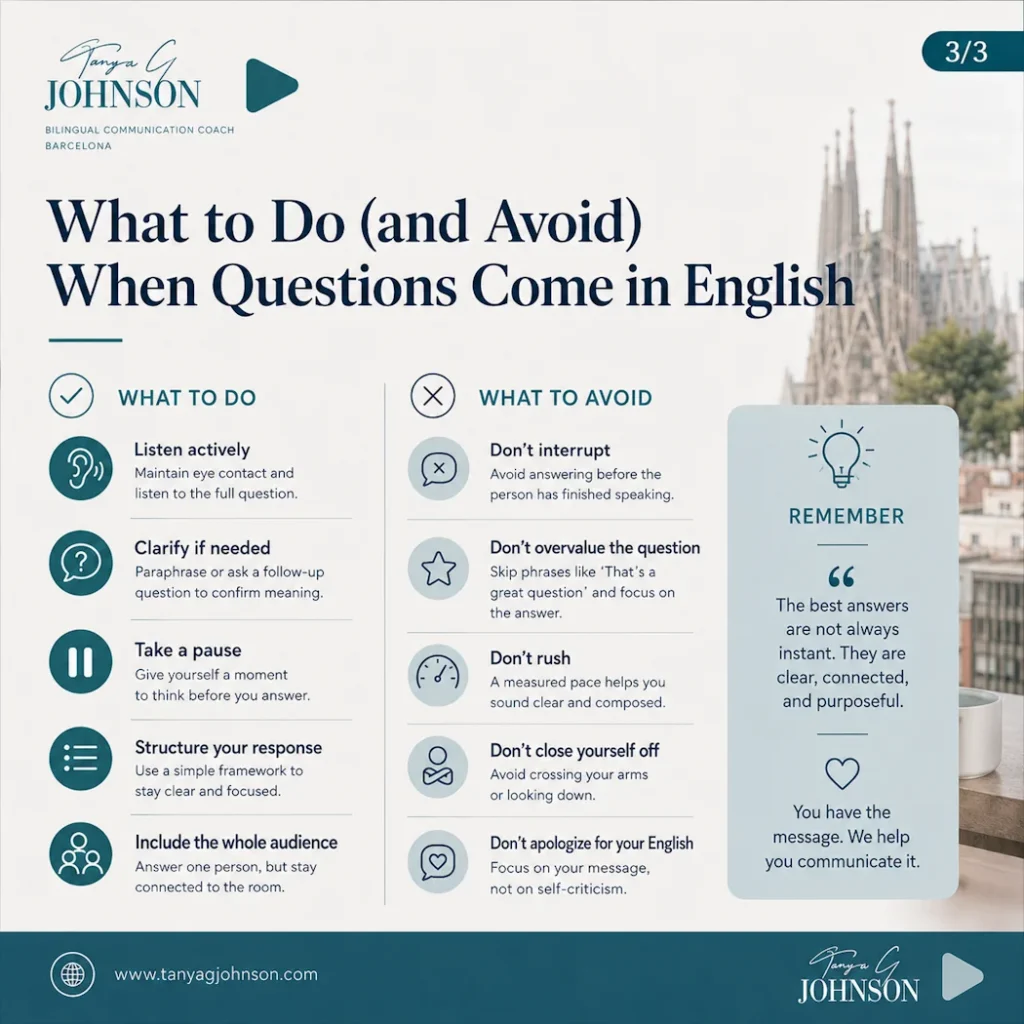
When the Q&A opens, it is common to move instinctively into a protective posture. You may cross your arms, bring your hands together in front of your body, hunch forward, or reduce eye contact. This reaction is natural, but it is also visible to the audience.
Keep your posture open, your arms relaxed, and your feet grounded. When someone asks a question, turn toward them and give them your full attention.
As you respond, include the rest of the audience with your eye contact. You are answering one person’s question, but you are still speaking to the whole room.
The professional presence you established during the presentation should continue into the Q&A.
Listen to the complete question
Stay connected with the person, maintain eye contact, and listen until they have finished speaking. Notice whether they are asking one clear question or several questions at once. Focus on what they genuinely want to know before deciding how to respond.
In a second language, it is easy to start preparing your answer while the other person is still speaking, especially when you are trying to hold on to the vocabulary you may need.
But when your attention moves too quickly to your answer, you may miss the real question.
Listening through to the end helps you understand more accurately and gives the person asking the question the sense that they have been heard.
Clarify what you have understood
You do not need to answer a question you have not fully understood.
Paraphrasing helps you confirm the meaning while giving yourself additional time to think. As you restate the question or ask a follow-up question, your mind can already begin organizing the response.
You might say:
- If I understand you correctly, you’re asking…
- So your question is about how this would work in practice. Is that right?
- Are you asking specifically about X or about Y?
- Could you clarify what you mean by…?
- Are you referring to the short-term result or the longer-term impact?
A follow-up question is especially helpful when the original question is broad, unclear, or contains several parts.
It is usually better to avoid praising or rating the question with phrases such as That’s a great question, That’s very interesting, or That’s an important question. This can unintentionally suggest that one person’s question is more valuable than another.
Paraphrasing keeps the focus where it belongs: understanding the question and preparing a clear response.
Give yourself time to respond
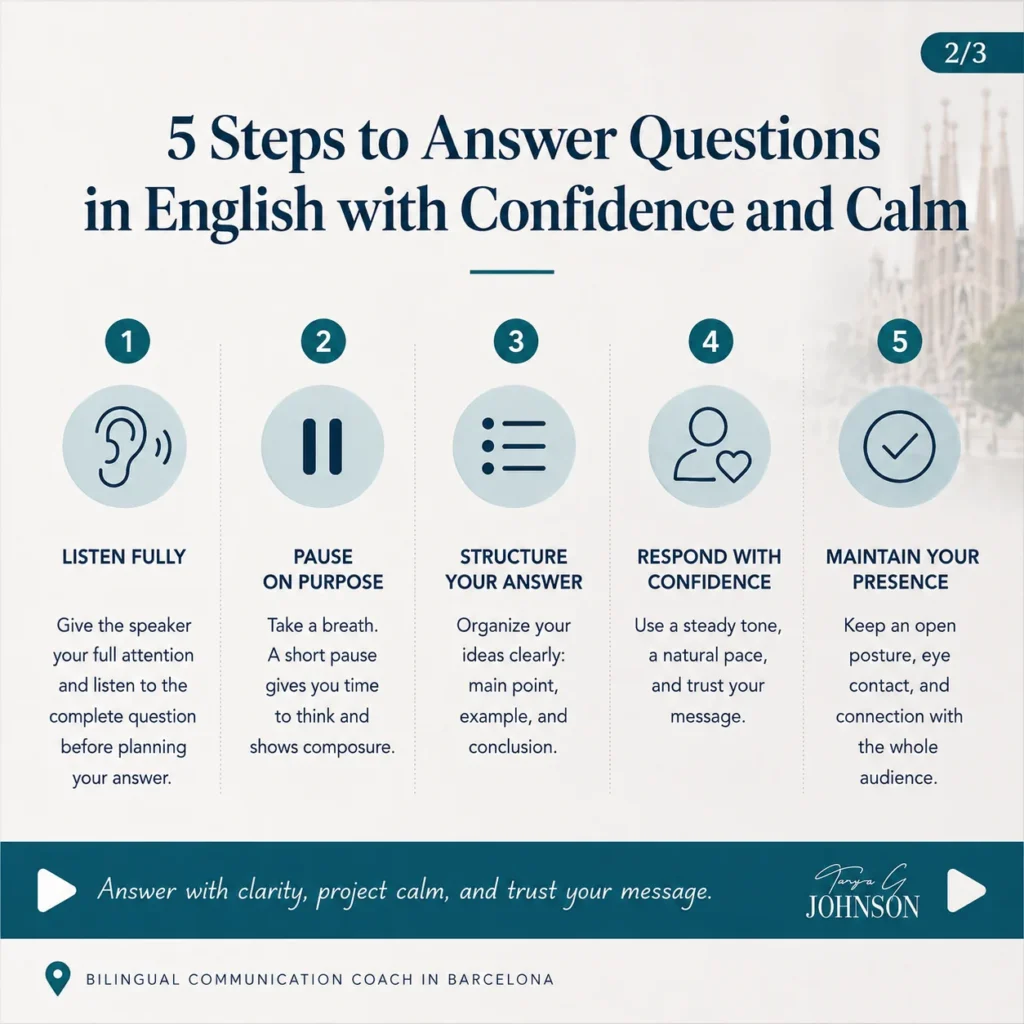
Once you have understood or clarified the question, pause.
You do not need to fill every second with words. Take a breath and give yourself the time you need to decide how you want to begin your answer.
A pause may feel longer to you than it does to the audience. For them, it is usually simply a sign that you are thinking. It also gives everyone a moment to absorb the question before you respond.
You do not need to announce the pause. Breathe, maintain eye contact, and think.
Speaking at a measured pace throughout the Q&A gives you more time to choose your words, organize each sentence, look at the audience, and read the room as you respond.
Structure your answer before you speak
You do not need to deliver a perfect answer immediately. A clear structure is usually more valuable than a quick response.
Before you begin speaking, decide on your main point. Then organize your answer in a simple way that is easy for the audience to follow.
Having a simple structure in mind can make spontaneous speaking much easier. For example:
- Start with your main recommendation, then explain why.
- Answer with two or three key points.
- Describe the situation, your response, and the outcome.
- Explain what happened first, what changed, and what you learned.
Once you know your structure, begin with a clear opening. Having a few opening phrases ready can help you stay calm, begin with confidence, and communicate that calm to your audience. Simple phrases such as “There are three reasons for that,” “I’d look at it from two perspectives,” or “My short answer is yes, and here’s why” give your audience a roadmap and give you a framework to follow.
A well-structured answer is easier for the audience to understand and easier for you to deliver, especially when you are speaking in a second language.
Use your body and voice to support your message
Your communication is shaped by much more than the words you choose.
As you answer, breathe naturally and speak at a measured pace. Use your voice, pauses, and gestures to reinforce your message and make it easier for people to follow.
Physical calm also supports clear thinking. When your body, voice, and words are working together, the audience is more likely to experience you as calm, confident, and credible.
Finish your answer clearly
A strong answer deserves a clear ending.
Once you have made your main point, avoid introducing new ideas simply because silence feels uncomfortable.
Instead, finish with intention. You may briefly reinforce your main message or summarize your recommendation in one final sentence before you stop speaking.
A clear ending helps the audience recognize that your answer is complete and makes you sound more confident and decisive. It also creates space for the next question. If people want more detail, they can always ask a follow-up question.
Prepare and practice for the Q&A
Preparing for the Q&A deserves as much attention as preparing the presentation itself.
Before an important presentation, think about the questions your audience is most likely to ask. Write them down. Include the questions you hope they won’t ask, such as concerns about cost, timing, implementation, evidence, limitations, or unresolved decisions.
Practice answering those questions aloud from beginning to end, including how you listen, pause, structure your response, and finish.
In my communication coaching, clients practice the Q&A using their real presentations, meetings, and professional situations. We record the practice sessions and review both the content of the answer and how it is communicated, including posture, eye contact, pace, voice, and connection with the audience.
This allows clients to see what changes under pressure and to rehearse a more open, grounded response. Confidence is practiced physically as well as verbally, making it easier to access when it matters most.
The goal is to experience what a confident answer feels like in your body, your voice, and your presence before you need it in front of an audience.
Answering questions with confidence
Responding well to questions is a skill that can be learned and practiced. The goal is to stay connected to your thinking, communicate clearly, and maintain your professional presence, even when you are under pressure.
The next time you face a Q&A, remember the process:
- Stay open and grounded.
- Listen to the complete question.
- Clarify when necessary.
- Give yourself time to think.
- Structure your answer.
- Use your body and voice to support your message.
- Finish clearly.
The more you practice these steps with real situations, the more natural they become. Over time, answering questions under pressure can become an opportunity to show how you think, communicate your judgment, and stay connected with your audience.
Frequently asked questions
What if I don’t know the answer?
You don’t have to answer every question immediately. It is perfectly professional to say that you need to check the information, think about it further, or follow up later. Responding honestly is far more credible than guessing or trying to hide your uncertainty.
How can I stop going blank during a Q&A?
Going blank often happens because you’re trying to listen, think, translate, and respond all at once. Listening carefully, clarifying the question, taking a brief pause, and using a simple structure can reduce that pressure and help you stay connected to your thinking. Breathing, staying grounded, and giving yourself permission to pause also help.
Can these techniques help even if English isn’t my first language?
Yes. These communication skills are valuable in any language, but they become especially important when you’re communicating in a second language. Practicing with realistic workplace situations helps you respond more naturally, communicate more clearly, and feel more confident under pressure.
Preparing for an important presentation?
If you’re preparing for a presentation, meeting, keynote, panel discussion, or interview where questions are likely, practicing with your own material can make a significant difference.
If you’d like support rehearsing realistic questions and strengthening how you respond under pressure, get in touch.